Alerting, digests & forecasts
kenny evaluates every telemetry snapshot with authoritative server-side health rules and
surfaces warn/crit on the dashboard — but in a family setting nobody watches a fleet
dashboard routinely. This page covers the push channel that reaches the operator's
phone when something needs action now, the daily summary that collects what can wait,
the change and forecast findings, and the weekly digest. It is entirely
server-side: no protocol bump, no agent involvement, thresholds stay in health_rules.py
(see ADR-0027,
ADR-0067 and
diffs.py / trends.py).
Who gets interrupted
Every notification carries a route that decides whether it interrupts anyone. The route is independent of whether it opens a ticket: routing decides interruption, auto-ticket rules decide work.
| Event | Route | What reaches a person |
|---|---|---|
A section escalates to crit |
push | One message now. Any warn lines from the same pass ride along as context |
A section escalates to warn only |
daily | A line in the next daily summary |
| A pushed episode recovers | push | Discord edits the original message; ntfy gets a silent low-priority note |
| An episode that was never pushed recovers | record | Nothing |
| A recovery the operator caused (a suppression) | record | Nothing. A Discord message is still edited |
A host goes silent for KENNY_ALERT_MISSING_AFTER_DAYS |
daily | A line in the next daily summary |
| A host goes offline or comes back | — | Nothing. Offline only pauses health evaluation |
| An inventory change on the allowlist | push | One message now |
| Any other inventory change | record | Nothing (Log page, digest counts) |
| A disk-fill forecast starts | daily | A line in the next daily summary, once per episode |
| A hardware forecast names a new device at risk | daily | A line in the next daily summary; announced again only when a new device or reason joins the set |
| Weekly digest | push | One message a week |
Human channels (ntfy, Discord) receive push only. The generic webhook is a machine
integration point: it receives every route, labelled with a route field, and filters for
itself. Every route writes the same events-table row and makes the same ticket decision.
Push alerting
A background loop on the server re-runs the health rules over every known agent's latest snapshot on a short interval (default 60 s) and notifies on transitions only — not on every push. The rules below decide whether a transition produces a notification; its route (above) decides who hears about it:
- Escalations to
critbypass the cooldown (ok→crit,warn→crit). warntransitions respect a per-scope cooldown (default 1 h) so a flapping section is bounded to one alert plus one recovery per window — no reminder spam.- An escalation that cannot be sent yet is held, not dropped. A cooldown used to
swallow a warn outright: the stored status advanced to the new value while nothing was
sent, so the next pass saw no change and the warning was lost for the whole episode. A
candidate now waits in a
pending:section:<name>scope and is delivered on the first pass that may send it, without the condition having to change again. - Some sections must be confirmed before they alarm. A section listed in
health_rules.CONFIRM_BEFORE_ALARM— todayreliability,hardware_errors,gpuandfans— has to report the same incident on a newercollected_atbefore it notifies. The loop runs every 60 s over a snapshot that changes every ~900 s, and these sections read a rolling event window (reliability,hardware_errors), flickering clock-event reasons (gpu) or a short burst of fan samples (fans), so one evaluation over one snapshot was enough to page someone and open a ticket for a finding that was gone by the next push. The cost is one push interval of latency on a genuine incident. - A recovery is only announced if the degrading episode was itself announced. An
improvement that nobody was told about stays silent, and
crit→warnupdates state quietly. - Posture never notifies. A section in the
posturetier (an unencrypted drive, a remote-access port, idle updater services — see the status model in telemetry.md) is a standing fact, not an event: every transition into or out of it only updates state, which is what gives the finding its age on the host page. It is listed once a week in the digest'sPosture:line. - The body is the finding, not the transition. A line reads
[CRIT] disk: C: 97% full (>=95%)and a recovery[RESOLVED] disk: C: 50% full; the title names the worst escalated section's reason. Theok -> critbookkeeping stays on the Log page.
The persisted flap-suppression state means a server restart never re-fires alerts for conditions that were already notified.
This loop scores reliability exactly like the dashboard
The reliability section is scored on whether each event pattern is still happening
and on the severity the categorizer assigned it — never on raw volume — and the
categorizer's verdicts are persisted and stamped onto every snapshot read (ADR-0058).
So the alert loop, the weekly digest below, the fleet list and the dashboard all reach
one verdict per host: a reboot storm that wrote 80 identical errors a week ago never
pages anyone, and a pattern firing every day does. An operator-suppressed pattern
(ADR-0041) is excluded from that scoring everywhere it runs. See the reliability row
in telemetry.md and
Alarm suppression.
Offline is silent; missing is not
An agent counts as offline when its newest snapshot is older than the offline
threshold (default 2700 s = three missed 15-min pushes) and the in-memory registry
holds no live tunnel connection. Health evaluation is skipped for offline agents, so a
stale snapshot can't flap. Being offline notifies no one: a PC that is switched off is
not an incident. A host with no telemetry for KENNY_ALERT_MISSING_AFTER_DAYS
(default 7) is missing. Its agent is broken or gone, which nobody would otherwise
notice, so it appears once in the daily summary and opens a ticket. When it reports
again, the ticket resolves quietly.
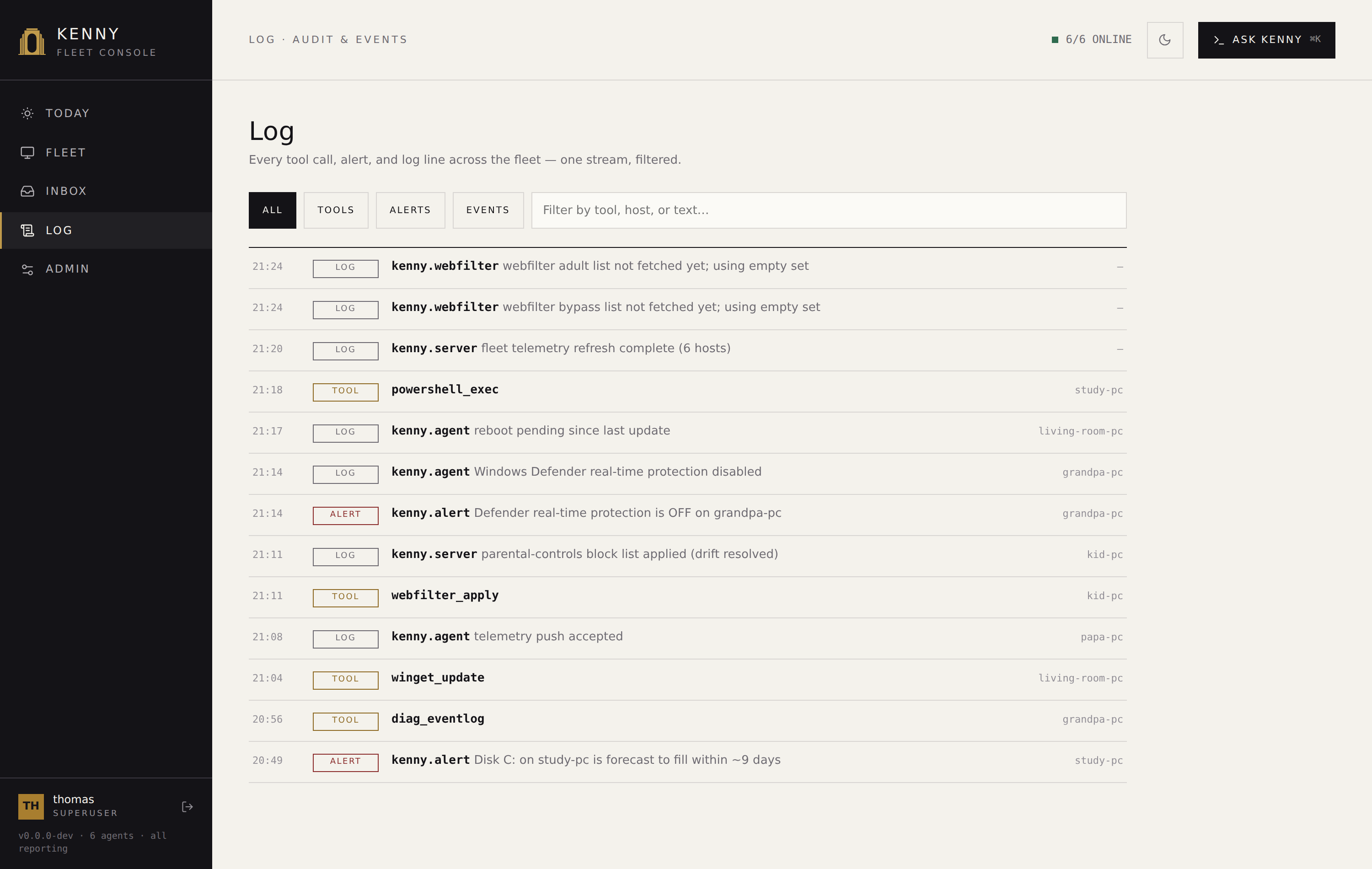
Every emitted alert is also written to the events table (kind='alert') as an audit
trail and as the weekly digest's input, so it shows up in the dashboard's Log
page with no extra UI plumbing.
An alert can open a ticket
A genuine alert (not a recovery, not the digest) can also open a ticket — the same ITSM record a Discord conversation or a dashboard action produces, so a Defender-disabled or a disk-forecast notification arrives with somewhere to work it rather than just a push you have to remember. This runs after delivery and is strictly best-effort: a failure to open the ticket is logged and swallowed, never lets a failing side effect make an alert late or lost — alerting must not become less reliable by gaining one.
An alert-origin ticket has no requester — it belongs to the fleet, not a person — so it
is operator-only in the Inbox: a scoped user never sees it. It
starts life pinned to the alerting agent, at high priority for a high/urgent
notification and normal otherwise, with the alert's own message as its opening summary.
One open ticket per subject
A condition that keeps re-crossing its threshold would otherwise mint a fresh ticket every
time it did. Instead, an alert is keyed by its subject — the host, plus the sections it
is about (or the producer's name, for offline, which is about the host itself). While a
ticket for that subject is still open, the alert is recorded on that ticket rather than
opening a second one, and it shows up in the ticket's own
alert history.
Two consequences worth knowing:
- A health finding and a disk-fill forecast about the same volume are one case. Both
name the
disksection, so the forecast attaches to the ticket the acute finding opened, or the other way round. A hardware forecast does the same with the section its device belongs to (disk_smart,gpu,fans,hardware_errors). - An inventory change never shares a ticket with a health finding, even on the same
section. "a new service appeared" and "a service is failing" are different kinds of fact:
only the second can come back to
ok, so only the second has a current state to check.
A resolved ticket does not suppress a new one: once somebody has dealt with the
condition, its return is news again.
Which events open a ticket is configurable
By default, every genuine alert — a health escalation, a host going missing, a disk-fill
or hardware forecast — opens a ticket, and a recovery, an inventory change, and the weekly digest never
do. An operator can narrow or widen that per fleet or per host from Admin → Alarm
rules (auto-ticket rules), or via the ticket_rule_*
MCP tools. Each rule names an event type (health / offline / disk_forecast /
hardware_forecast / change), an optional section and host, and a decision: open_all (always), open_crit
(only when the subject is crit) or never.
Two practical cases this solves:
- A machine that is retired but not yet removed keeps a missing ticket open. A
neverrule onofflinefor that host stops the ticket without removing the finding from the daily summary or the events-table audit trail. - Inventory changes never open a ticket by default, even though a new local administrator
account is exactly the kind of thing worth a ticket. An
open_allrule onchangewith sectionlocal_accountspromotes it.
Three sections depart from the open_all default: a reliability, hardware_errors
or gpu warn does not open a ticket, only a crit does. What those sections warn about is
real but not urgent — a PC that asks for its BitLocker recovery key on every restart, one unexpected
restart on an otherwise healthy machine. Those are worth seeing on the host page and worth
one notification; on a four-host family fleet, one queue item each is what buried the
queue. Any operator rule still overrides this.
Recoveries and the weekly digest can never open a ticket, no matter what rule is written — the rule engine only ever narrows or widens genuine alerts, and running the empty rule table through the same decision path reproduces this section's coded default exactly.
A ticket an alert opened closes when the condition goes
A recovery resolves the ticket its alert opened, matched on the same subject key the
ticket was opened with. Without it the surface only ever accumulated: a recovery is never
itself ticketed, crit→warn is silent, and the ticket sweep does not read health — so an
automatically opened ticket could only ever be closed by a person, even after the condition
had cleared.
This includes clearing it by decision rather than by repair: adding a reliability suppression rule re-evaluates the affected hosts immediately, which produces the ordinary recovery transition, which closes the ticket. Muting a pattern takes back the work it created instead of leaving it in the queue.
Change notifications
A diff step in the same loop compares consecutive snapshots (once per new snapshot, tracked by a persisted cursor — never per evaluation tick, and never re-diffed after a restart) and reports what appeared, disappeared or changed in the inventory sections:
| Section | Diffed on |
|---|---|
autostart |
entry added/removed, command changed |
services |
service added/removed, start type changed |
peripherals |
device added/removed |
installed_software |
app added/removed, version changed |
browser_extensions |
extension added/removed |
listening_ports |
port added/removed |
scheduled_tasks |
task added/removed, action changed |
local_accounts |
account added/removed, admin/enabled changed |
Most of these are routine: software updates, a USB stick, a service switching start type.
Only changes on the push allowlist (KENNY_ALERT_CHANGE_PUSH, a comma list of
section or section:kind) push. The default is local_accounts (every kind) plus
autostart:added, scheduled_tasks:added and browser_extensions:added. Those are new
persistence mechanisms and any account drift, which are rare and each worth an
interruption. changed kinds and listening_ports stay off by default: updaters rewrite
autostart and task commands on every update, and processes open ephemeral ports all day.
- An allowlisted change is never held back by the section cooldown. Dropping a new autostart entry because another appeared within the hour would be a security miss, and an allowlisted entry that flaps is a signal in itself.
- Every other change is recorded (Log page, digest counts) under the per-section cooldown.
- Each host's changes from one snapshot become at most one pushed and one recorded notification.
local_accountschanges (a new account, or one flipped to admin/enabled) are high priority, the highest-signal security question in a family fleet.- Sections absent from either snapshot are skipped, so rolling out a new collector never floods the diff with "added" rows for a whole section.
Forecasts
trends.py fits ordinary least squares over the per-day history (one representative
snapshot per UTC day). Forecasts are deliberately shy — they need at least 5 daily
points, a genuinely rising slope and a decent fit (r² ≥ 0.5), else they return nothing
rather than a scary made-up number:
- Disk-fill forecast — days until full per volume. Dropping under ~14 days raises
one alert per episode, listed in the daily summary on the
diskline; under ~30 days shows as a Today KPI and in the weekly digest. The forecast names thedisksection, so it shares a ticket with an acute disk finding on the same host, and an auto-ticket rule can targetdisk_forecast+disk. - Battery drift — health change as percent per 30 days; a meaningful decline appears in the digest.
-
Hardware forecasts — slow precursors of a hardware failure, read from the two-year per-device history rather than the 30-day snapshots (ADR-0070). The health rules judge what a device is doing now; these judge which way it is heading. Each names the device and says what is happening in plain words:
Reason Device Raised when wear_outSSD percentage_usedis projected to reach 100 within 180 days or is already there; the fit needs at least 21 days of data spanning 30 calendar days and either two step changes or a 2-point rise, because the counter moves in whole percentspare_declineNVMe available_spareis projected to reach the drive's own safety threshold within 90 days or already has, on the same evidence floor aswear_outfirst_errordisk a lifetime counter (media errors, SMART 197 / 198 / 5, uncorrected read/write) first left zero within the last 30 days; a counter that was already non-zero when observation began, or that rises again later, is a standing fact, not news pcie_width_regressionGPU the widest link seen under load was below the card's own historic best on at least 3 of the last 7 days (an x4 slot is by design; only a drop counts) fan_driftfan in every duty band with data, the last 7 days' median RPM is at least 12 % below the fan's own baseline (its first 30 days), on at least 5 of the 7 days — a change of fan curve does not trigger it error_rate_risingcomponent a hardware-error count (events, EDAC or PCIe counters) over the last 7 days is at least twice the weekly rate of the 21 days before, with at least 3 events and two weeks of history A device with no data for 14 days is treated as gone (replaced or removed), not failing; a counter that decreases is a reset, not a recovery. A forecast raises one
hardware_forecastalert per host, routeddaily, which names every section its devices belong to (disk_smart,gpu,fans,hardware_errors) so it shares a ticket with the section's own finding. A device and reason already announced is not news again; a new one is. By default ahardware_forecastopens a ticket (open_all), and an auto-ticket rule can targethardware_forecastwith one of those sections. The weekly digest names each such host in its to-do line under hardware at risk, and Today counts them in its Hardware at risk KPI.
These same computations feed the per-host Forecast panel at the top of the host page, which synthesizes them (with the inventory diff) into a short prose outlook and lists the hardware at risk beneath it.
Daily summary
What can wait is collected into one message a day at KENNY_ALERT_DAILY_HOUR (UTC,
default 08:00):
- It lists findings routed
dailysince the last summary that are still open now: warn findings, missing hosts, disk and hardware forecasts. One line per host and section, with the current reason and how long it has been open. A finding that came and went in between is left out. - A crit that was already pushed is not repeated. It counts towards the
N older finding(s)
  still open
line, which is followed by a link to the Inbox whenKENNY_PUBLIC_URLis set. - Nothing is sent when nothing is new.
- The weekly digest's slot is skipped, so that morning brings one message.
- Its state is persisted like the digest's, so a restart neither loses nor repeats a summary.
- It never opens a ticket; the findings it lists have their own.
Weekly digest
A short weekly overview is scheduled inside the same loop and sent on the same channels at low priority. It is a summary to click through, not a report: the detail behind every line is on the dashboard. Rendered from data already in the stores, it holds:
- the fleet health mix and how many hosts are online;
- In short: one or two sentences in which the fast model reads the same facts and
names the host or item that most deserves attention this week, joining what the lines
below list separately (a host that is filling up, wearing out and failing updates is
one finding). It is an annotation, never the record: the lines below are computed and
unchanged. It is left out when the Weekly digest summary feature
(
KENNY_AI_DIGEST_ENABLED, Admin → AI) is off, no API key or gateway is set, or the model answers late (30 s) or unusably; - one line per host that needs attention, with the names of its sections at that
severity (crit hosts first, at most 8 lines, the rest as
+N more hosts). Rule reasons such as KB numbers or percentages are left to the host page; - 7-day alert (and crit) and change counts;
- a to-do line: pending reboots, failed updates and on how many hosts, OS end of life,
hosts with a disk filling within 30 days (one entry per host, its soonest volume),
battery wear, and hosts with hardware at risk (one entry per host with its number of
hardware_forecastfindings, linked to the section that holds the evidence); - posture findings as a count per host;
- 7-day screen time per host.
When KENNY_PUBLIC_URL is set, Discord shows every host name as a link to its host page
(opened at the relevant section), the alert count as a link to the Log, and a closing
Open kenny link to the fleet. ntfy and the generic webhook get the same overview as
plain text ending in one Details: URL. Without KENNY_PUBLIC_URL the digest carries no
links.
- Scheduled by default Monday 08:00 (
KENNY_DIGEST_DAY/KENNY_DIGEST_HOUR); the last-sent time is persisted so a restart never double-sends, and the first digest arrives at the next scheduled slot rather than on install. - Only sent if
KENNY_DIGEST_ENABLEDis on and at least one notifier is configured. - Preview it without sending via Preview digest in Admin → Alerts & notifications,
or the operator-only endpoint
GET /api/digest/preview.
Notification channels
Delivery goes through three best-effort channels, all off unless configured (a single HTTP POST each):
| Channel | Setting | Payload |
|---|---|---|
| ntfy | KENNY_NTFY_URL (+ optional KENNY_NTFY_TOKEN bearer) |
POST body to an ntfy topic; title/priority/tags as headers — works out of the box with the ntfy phone apps |
| Generic webhook | KENNY_WEBHOOK_URL |
JSON POST (kind, route, title, body, priority, tags, agent_id, event_type, sections, at) — every route, not only pushes |
| Discord | KENNY_DISCORD_WEBHOOK_URL |
A Discord embed with one line per finding, coloured by severity (red crit, amber warn, green resolved, grey informational), a timestamp, and a link to the host page when KENNY_PUBLIC_URL is set (in the weekly digest, each host name links to its host page) |
A pushed health alert on Discord is one message that shows its current state:
- kenny posts with
?wait=true, keeps the returned message id for 30 days, and on recovery edits that message instead of posting another one. - A finding that resolves is struck through. Once every finding has resolved, the message turns green and says when and after how long.
- An edit does not notify anyone in Discord.
- If the message is gone (deleted, or the webhook URL was replaced), the edit is dropped.
Set them in Admin → Alerts & notifications, or in the environment. A value saved in the dashboard wins over the environment and takes effect on the next alert, with no restart. Clearing the field turns the channel off — it does not fall back to the environment value, because a field an operator has just emptied should not keep delivering. Resetting the row to its default is what hands control back to the environment.
The values are write-only in the dashboard: a saved token or webhook URL is never read back, only replaced. A webhook URL is bearer-equivalent — whoever holds it can receive your alerts — so treat it as a secret in either location (ADR-0054).
Delivery is strictly best-effort: send errors are logged and swallowed, a dead target never stalls or kills the loop. With no channel configured, evaluation still runs and records alert history — it just pushes nothing.
To check the channels without waiting for a real alert, Send test notification in the
same Admin section (superuser only, POST /api/notify/test) sends one test message through
every configured channel directly — not through the alert engine, so it opens no ticket and
touches no cooldown — and lists each channel as delivered or failed · <reason>.
Configuration
Every key below except KENNY_ALERT_INTERVAL_SECS is also editable in Admin → Alerts &
notifications, where a saved value wins over the environment and applies on the next
alert pass. KENNY_ALERT_INTERVAL_SECS is set in the environment only and read at startup.
See setup.md for the full list.
| Variable | Default | Purpose |
|---|---|---|
KENNY_ALERT_INTERVAL_SECS |
60 |
Evaluation interval; 0 disables the loop |
KENNY_ALERT_COOLDOWN_SECS |
3600 |
Per-scope flap suppression window |
KENNY_ALERT_OFFLINE_AFTER_SECS |
2700 |
Offline after this (three missed 15-min pushes); pauses health evaluation, notifies no one |
KENNY_ALERT_MISSING_AFTER_DAYS |
7 |
A host silent this long is missing (daily summary + ticket) |
KENNY_ALERT_DAILY_HOUR |
8 |
Daily summary hour (0–23, UTC) |
KENNY_ALERT_CHANGE_PUSH |
local_accounts,autostart:added,scheduled_tasks:added,browser_extensions:added |
Inventory changes that push; the rest are recorded |
KENNY_DIGEST_ENABLED |
1 |
Send the weekly digest |
KENNY_DIGEST_DAY |
mon |
Digest day of week |
KENNY_DIGEST_HOUR |
8 |
Digest hour (0–23) |
KENNY_NTFY_URL |
(empty) | ntfy topic URL; empty = channel off |
KENNY_NTFY_TOKEN |
(empty) | Optional ntfy bearer token |
KENNY_WEBHOOK_URL |
(empty) | Generic JSON webhook URL; empty = channel off |
KENNY_DISCORD_WEBHOOK_URL |
(empty) | Discord webhook URL; empty = channel off |
See also
setup.md— hosting, TLS, and the full environment-variable listdashboard.md— the Today KPIs and the per-host Forecast paneltelemetry.md— the sections and health rules these alerts evaluateitsm.md— tickets, the Discord bot, and what an alert-opened ticket looks like- ADR-0027 — push alerting & weekly digest
- ADR-0067 — routes, the daily summary, editing in place
- ADR-0070 — the per-device hardware history the hardware forecasts are fitted on
kenny-server/kenny_server/ticket_rules.py— the auto-ticket rule model, and why an empty rule table reproduces the coded default